About 50 min one-to-one, or 60 min with a small group
1. Warm up (5 to 10 min): Ask the quick questions with notes closed.
2. Teach: Work through the lesson slides in order.
3. Coach practice: Use the student examples and try-it tasks.
4. Check: Finish with the outcome prompts below.
Warm-up questions
At the beach on a sunny day, why is the sand hot while the water is still cool?Listen for: Water needs more energy to warm up. This sets up specific heat capacity.
When ice melts in a glass, does its temperature rise while it melts?Listen for: It stays at 0 °C until the ice is gone. Many expect the temperature to climb.
Is temperature the same thing as thermal energy?Listen for: Temperature is average particle motion, and thermal energy also depends on how much material there is.
What to check they understood
D2.4
Ask them to calculate the energy to warm 2.0 kg of water by 5.0 °C, with c equal to 4.19 J/(g·°C).
A strong answer converts to 2000 g, uses Q = mcΔt to get about 41.9 kJ, and keeps the units throughout.
D2.5
Ask them to choose the right equation for melting a block of ice at 0 °C and explain the choice.
A strong answer picks the heat of fusion, because a phase change is happening and the temperature stays the same.
Likely gaps from earlier grades
Unit conversions from kilograms to grams and joules to kilojoules are often slow. Practise one of each first.
Class slides
Work through the class slides
1 / 5
Sand and lake water cooling
After sunset, dry land often changes temperature faster than a nearby large body of water.
Equal energy input can produce different temperature changes because materials have different specific heat capacities.
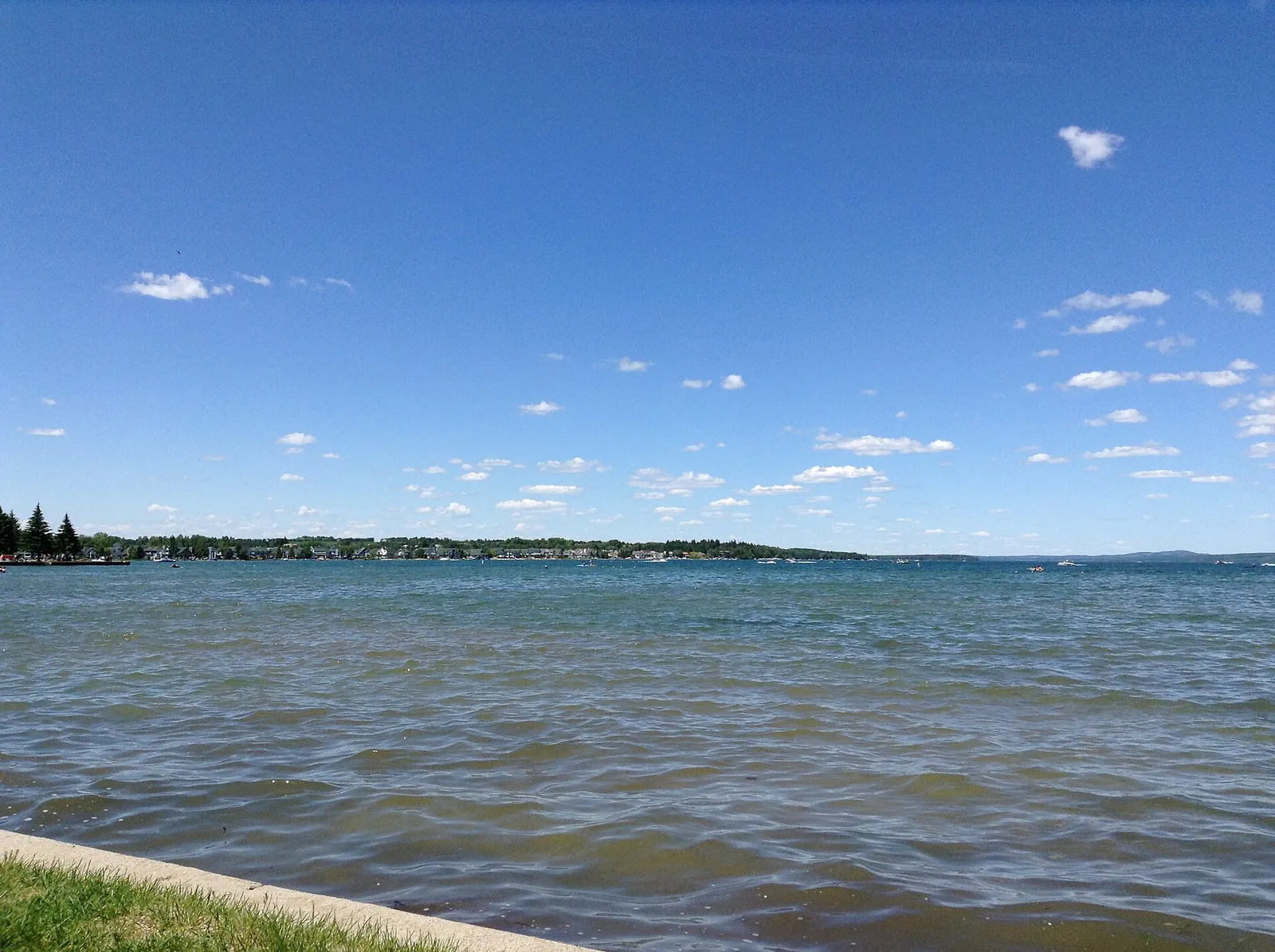
On a summer day at Sylvan Lake, the land along the shore heats quickly and cools quickly after sunset. The lake water warms slowly and holds its heat, so evenings beside the water stay milder.