About 50 min one-to-one, or 60 min with a small group
1. Warm up (5 to 10 min): Ask the quick questions with notes closed.
2. Teach: Work through the lesson slides in order.
3. Coach practice: Use the student examples and try-it tasks.
4. Check: Finish with the outcome prompts below.
Warm-up questions
What makes a grassland different from a boreal forest, apart from the plants?Listen for: Temperature, precipitation and soil. Many define a biome by its organisms only.
Name one thing that enters a forest from outside it and one thing that leaves.Listen for: Sunlight and rain enter, and water vapour and heat leave. This sets up inputs and outputs.
Earlier, tutors described a cell as an open system. What would make a biome open too?Listen for: Matter and energy cross its boundary. This links back to unit C.
What to check they understood
D3.1
Ask them to choose a biome and list two energy exchanges and two matter exchanges across its boundary.
A strong answer names a boundary, gives energy examples such as sunlight in and infrared out, and matter examples such as rain in and streams or migrating animals out.
D3.1
Ask them to compare a biome with a cell as open systems.
A strong answer says both have a boundary that matter and energy cross, and both transform what comes in.
Likely gaps from earlier grades
Students may be unclear on the difference between energy flowing through and matter cycling. Ask which one is reused.
Class slides
Work through the class slides
1 / 5
Grassland boundaries
Sunlight, water, organisms, gases, and nutrients cross any chosen biome boundary.
Matter cycles within and across the boundary while energy flows through and leaves mainly as thermal energy.
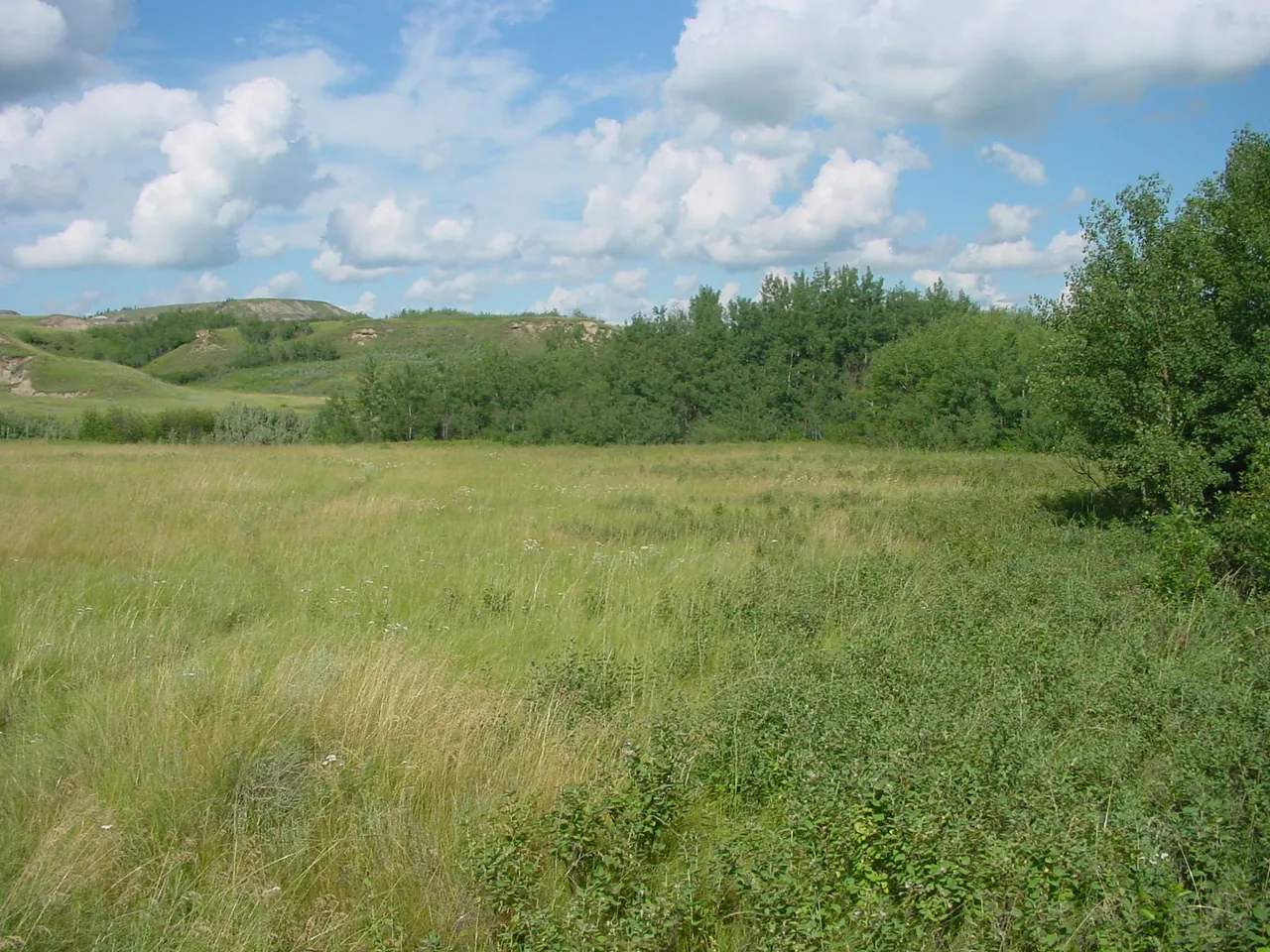
At Dry Island Buffalo Jump in Alberta, open grassland and aspen groves blend into each other. Seeds, water, animals, and air move across any boundary students draw. A scientist picks one boundary for study and says where it is.