About 50 min one-to-one, or 60 min with a small group
1. Warm up (5 to 10 min): Ask the quick questions with notes closed.
2. Teach: Work through the lesson slides in order.
3. Coach practice: Use the student examples and try-it tasks.
4. Check: Finish with the outcome prompts below.
Warm-up questions
A ball sits still on a high shelf. Does it have any energy?Listen for: Yes, gravitational potential energy because of its height. Many say it has none because it is still.
Where is the energy in a sandwich, and how does their body get it out?Listen for: Stored in the chemical bonds of the food, released by reactions in their cells.
What happens to a stretched elastic band's energy when tutors let it go?Listen for: It becomes motion, then sound and thermal energy. This tests the idea of stored energy by condition.
What to check they understood
B2.2
Ask them to describe the energy of a ball as it drops from a shelf, at the top, halfway and just before it lands.
A strong answer says it is all potential at the top, part potential and part kinetic halfway, and almost all kinetic just before landing.
B2.3
Ask them to explain why chemical energy counts as a kind of potential energy.
A strong answer says the energy is stored in the arrangement of atoms in a substance such as glucose or gasoline, and is released when a reaction rearranges them.
B2.1
Ask them to give two observations that show energy is present in a system.
A strong answer gives examples such as a change in motion, shape or temperature, or a chemical change such as burning.
Likely gaps from earlier grades
Earlier grades use the word energy loosely. Push for a named form and a piece of evidence each time.
Class slides
Work through the class slides
1 / 5
A ball at rest and in motion
A ball held still above the floor has gravitational potential energy.
After release, its speed increases as gravitational potential energy is transformed into kinetic energy.
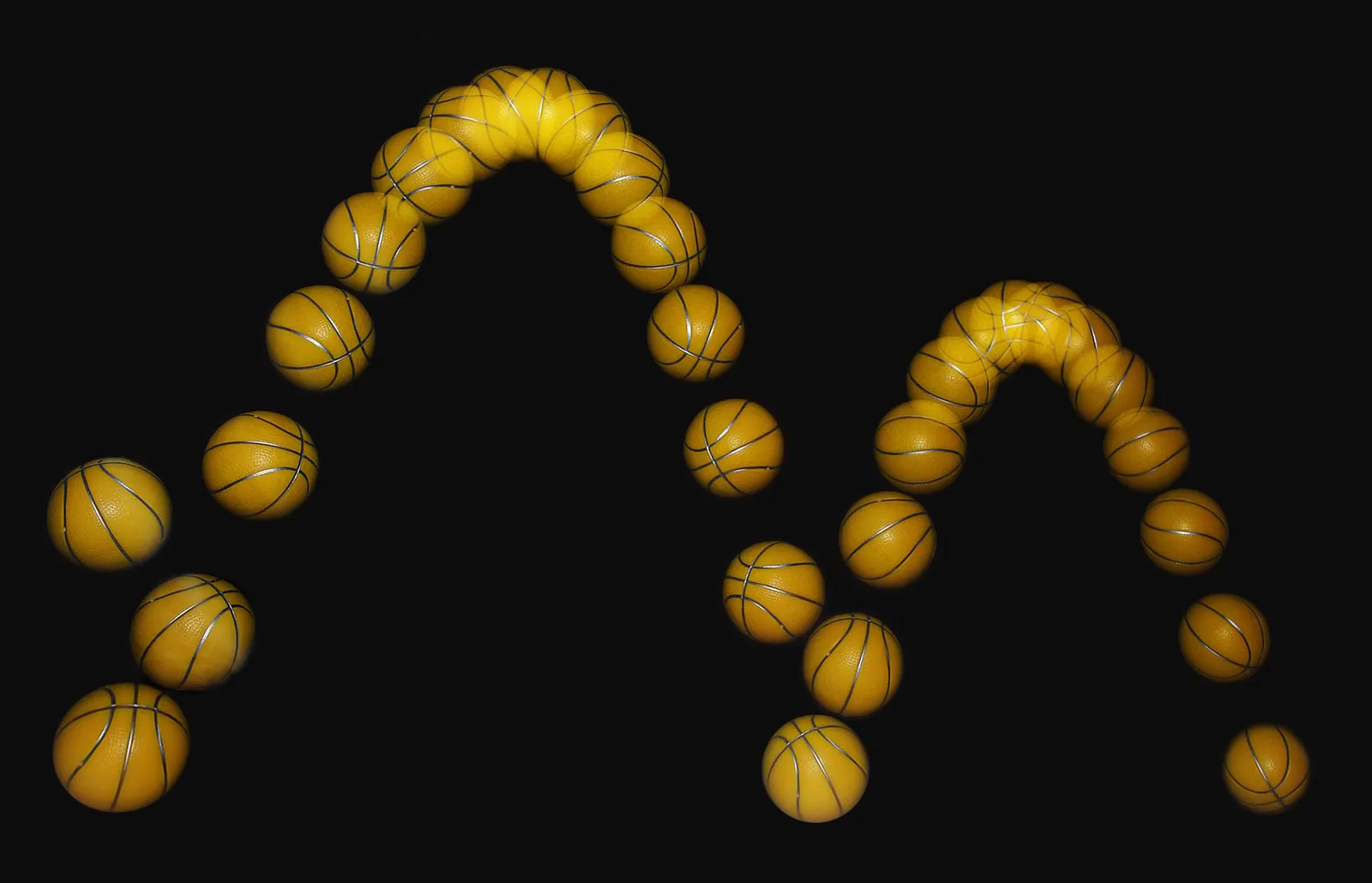
A flashing light caught one ball many times each second. Near the top of each arc the images crowd together, because the ball moves slowly and holds more potential energy. Near the floor they spread apart, because the ball moves fast and holds more kinetic energy.