About 50 min one-to-one, or 60 min with a small group
1. Warm up (5 to 10 min): Ask the quick questions with notes closed.
2. Teach: Work through the lesson slides in order.
3. Coach practice: Use the student examples and try-it tasks.
4. Check: Finish with the outcome prompts below.
Warm-up questions
A cart rolls down a ramp. Where does its speed at the bottom come from?Listen for: From the height it started at. Watch for the idea that the energy just disappears as it rolls down.
Why does a swing slowly stop if nobody pushes it?Listen for: Friction and air resistance turn some energy into thermal energy and sound.
If tutors wanted to test whether release height changes final speed, what would tutors keep the same?Listen for: The cart, the ramp surface and the way it is released. This is the controlled variables idea.
What to check they understood
B2.13
Ask them to name the manipulated, responding and controlled variables in the ramp investigation.
A strong answer gives release height as manipulated, final speed as responding, and the cart, ramp and surface as controlled.
B2.13
Ask them to explain why the measured speed at the bottom is a bit lower than the energy calculation predicts.
A strong answer says friction turned some potential energy into thermal energy, so less became kinetic energy.
Likely gaps from earlier grades
Planning a fair test is a Grade 7 to 9 skill that may need a refresher. Use the ramp to name each variable aloud.
Class slides
Work through the class slides
1 / 5
Height and speed on a ramp
A cart released from a higher point reaches the bottom of a ramp at a greater speed.
With small friction, decreasing gravitational potential energy corresponds to increasing kinetic energy.
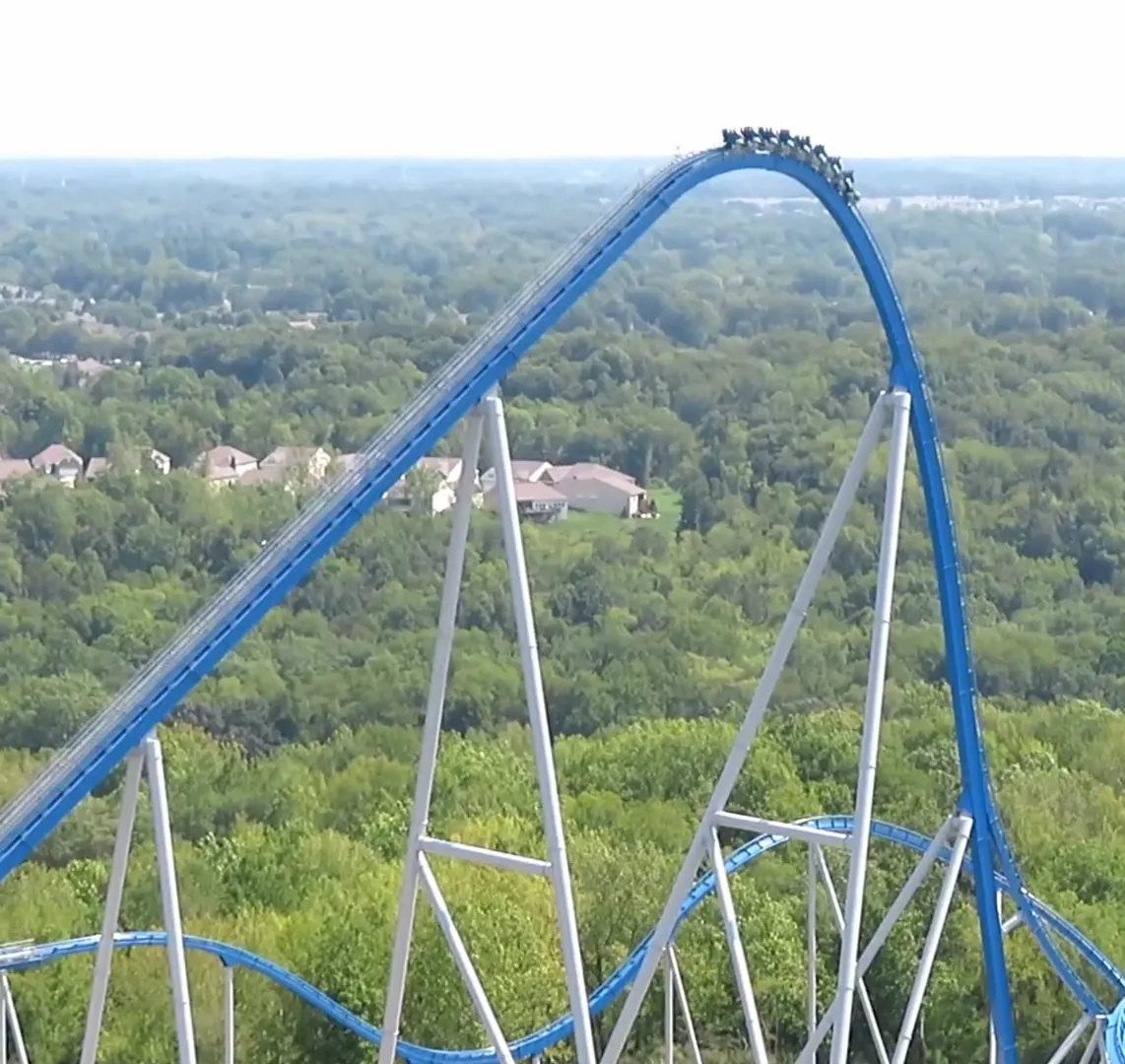
A coaster train is pulled up to the highest point and then released. As it falls, gravitational potential energy changes into kinetic energy. The train reaches its greatest speed at the bottom of the tallest drop.