About 50 min one-to-one, or 60 min with a small group
1. Warm up (5 to 10 min): Ask the quick questions with notes closed.
2. Teach: Work through the lesson slides in order.
3. Coach practice: Use the student examples and try-it tasks.
4. Check: Finish with the outcome prompts below.
Warm-up questions
Alberta makes electricity from natural gas, wind, solar and other sources. What makes one choice better than another?Listen for: Cost, pollution, reliability or efficiency. A list with more than one factor is a strong start.
If tutors put 100 J into a device and get 25 J of useful output, what fraction is useful?Listen for: One quarter, or 25 percent. This checks fraction and percent skills.
Why might a high-efficiency furnace cost more to buy but save money later?Listen for: It turns more of the fuel's energy into heat for the house, so it burns less fuel over time.
What to check they understood
B3.5
Ask them to calculate the efficiency of a furnace that delivers 85 MJ of heat to a house from 100 MJ of fuel energy.
A strong answer divides useful output by input to get 0.85, or 85 percent, and states both forms.
B3.7
Ask them to compare coal and natural gas for an Alberta power plant on one cost and one benefit.
A strong answer says natural gas plants are usually more efficient and release less carbon dioxide per unit of energy, and weighs that against fuel price or supply.
B3.8
Ask them to give one reason efficiency matters for the environment.
A strong answer says higher efficiency means less fuel burned for the same useful output, so fewer emissions and less use of natural resources.
Likely gaps from earlier grades
Converting decimals to percentages may be shaky. Check it with one quick example.
Class slides
Work through the class slides
1 / 5
Energy losses in a device
A device receives 100 J and delivers 35 J as useful output.
Its efficiency is 35%; the remaining 65 J is transferred in other forms, often thermal energy.
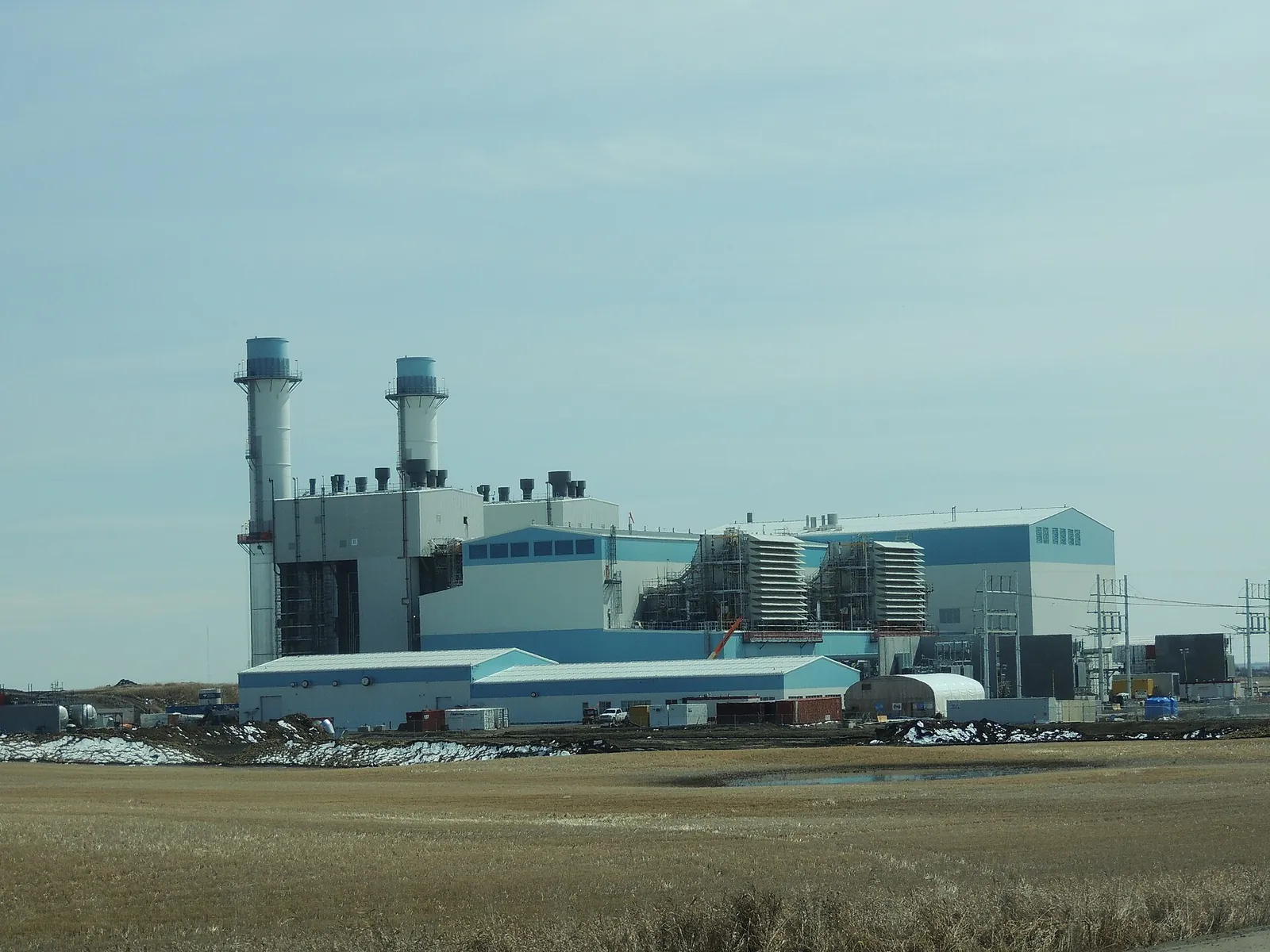
Shepard Energy Centre in Calgary burns natural gas to make electricity. Only part of the fuel's chemical energy leaves as electrical energy. The rest leaves as thermal energy through the exhaust and the cooling system, like the missing 65 joules in this example.