About 50 min one-to-one, or 60 min with a small group
1. Warm up (5 to 10 min): Ask the quick questions with notes closed.
2. Teach: Work through the lesson slides in order.
3. Coach practice: Use the student examples and try-it tasks.
4. Check: Finish with the outcome prompts below.
Warm-up questions
Why does a satellite stay up without falling to Earth?Listen for: It is falling, but moving sideways fast enough to keep missing Earth. Listen for falling plus sideways motion.
What shape is a planet's orbit around the Sun?Listen for: An ellipse, close to a circle for Earth. This checks Kepler's first law.
Why do planets far from the Sun take longer to orbit?Listen for: They travel farther and move more slowly. Any idea of a link between distance and period is good.
What to check they understood
20-C1.5k
Ask them to state Kepler's three laws in their own words.
A strong answer says orbits are ellipses with the Sun at one focus, a planet sweeps equal areas in equal times so it moves faster near the Sun, and the period squared is proportional to the average radius cubed.
20-C1.7k
Ask them to explain how gravity provides the centripetal force for a satellite in orbit.
A strong answer says gravity pulls the satellite toward Earth's centre, and at the right speed that pull exactly matches the force needed to keep it moving in a circle.
Likely gaps from earlier grades
Students often think there is no gravity where satellites orbit. Gravity there is still about 90% as strong as on the ground.
Class slides
Work through the class slides
1 / 7
A moonlet circles a giant
A small satellite orbits a planet at radius 4.20 times 10 to the seventh metres with speed 3.50 times 10 to the third m/s.
The gravitational pull toward the planet is the centripetal force, so the planet's mass can be read from the orbit.
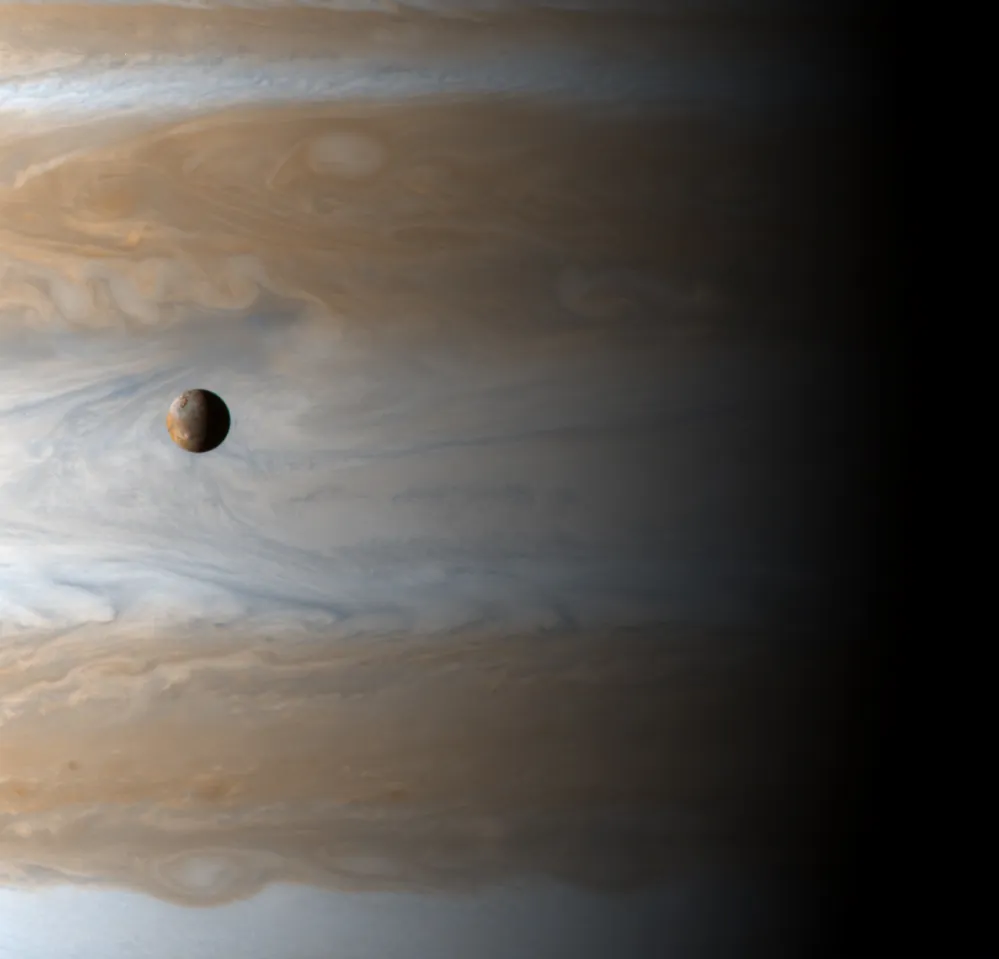
The Cassini spacecraft photographed Io in front of Jupiter on 1 January 2001. Io circles Jupiter about once every 42 hours. Gravity from the giant planet supplies the centripetal force, and timing an orbit like this one lets scientists calculate Jupiter's mass.