About 50 min one-to-one, or 60 min with a small group
1. Warm up (5 to 10 min): Ask the quick questions with notes closed.
2. Teach: Work through the lesson slides in order.
3. Coach practice: Use the student examples and try-it tasks.
4. Check: Finish with the outcome prompts below.
Warm-up questions
A ball is held above the floor. What kind of energy does it have, and what happens when tutors drop it?Listen for: Gravitational potential energy turning into kinetic energy. Listen for the change of form.
Why does a roller coaster's first hill have to be the tallest?Listen for: It sets the total energy available for the ride. This checks conservation.
If tutors double the speed of a bike, what happens to its kinetic energy?Listen for: It becomes four times larger. Any guess opens the speed squared idea.
What to check they understood
20-C2.1k
Ask them to calculate the kinetic energy of a 60 kg cyclist moving at 5.0 m/s.
A strong answer uses one half m v² to get one half times 60 times 25, which is 750 J.
20-C2.3k
Ask them to use conservation of energy to find the speed of a ball at the bottom of a 2.0 m drop.
A strong answer sets m g h equal to one half m v², cancels the mass, and gets the square root of 2 times 9.81 times 2.0, about 6.3 m/s.
Likely gaps from earlier grades
Students often think doubling speed doubles kinetic energy. Show the square in the formula.
Class slides
Work through the class slides
1 / 7
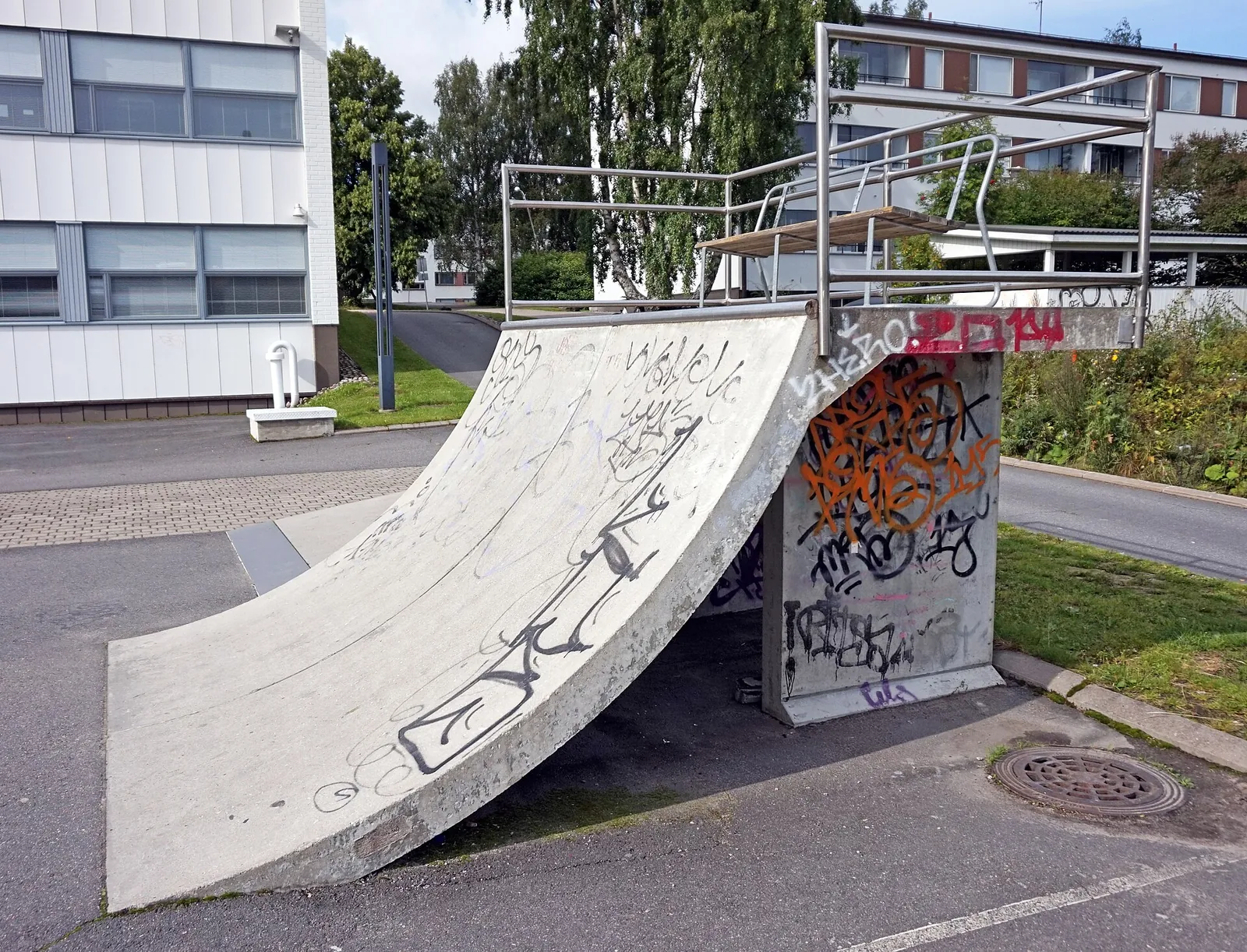
A skateboarder drops in from 3.20 m
A 48.0 kg skateboarder starts from rest at a height of 3.20 m on a quarter pipe.
At the bottom the height is zero on the chosen scale, and the speed is 7.92 m/s.
A quarter pipe ramp. A skateboarder who starts at rest at the top has gravitational potential energy. Rolling down the curve turns that energy into kinetic energy, and with little friction the total mechanical energy stays nearly the same.