About 30 min one-to-one, or 40 min with a small group
1. Warm up (5 to 10 min): Ask the quick questions with notes closed.
2. Teach: Work through the lesson slides in order.
3. Coach practice: Use the student examples and try-it tasks.
4. Check: Finish with the outcome prompts below.
Warm-up questions
Why does a can of soup need a label of a certain size?Listen for: The label wraps the curved surface, so its size depends on the can's height and distance around. Listen for surface area.
If tutors double the side of a cube, what happens to its volume?Listen for: It becomes eight times larger. This tests scaling intuition.
What is the difference between surface area and volume?Listen for: Surface area covers the outside; volume fills the inside. This checks the core distinction.
What to check they understood
M3
Ask them to find the surface area and volume of a cylinder with radius 4 cm and height 10 cm.
A strong answer uses two times pi r squared plus two pi r h to get about 352 square centimetres, and pi r squared h to get about 503 cubic centimetres, with correct units.
M3
Ask them to find the volume of a cone and a cylinder with the same base and height, and explain how they compare.
A strong answer calculates both and shows that the cone's volume is one third of the cylinder's, linking the formulas.
Likely gaps from earlier grades
Students mix up square and cubic units. Ask whether they are covering or filling.
Class slides
Work through the class slides
1 / 11
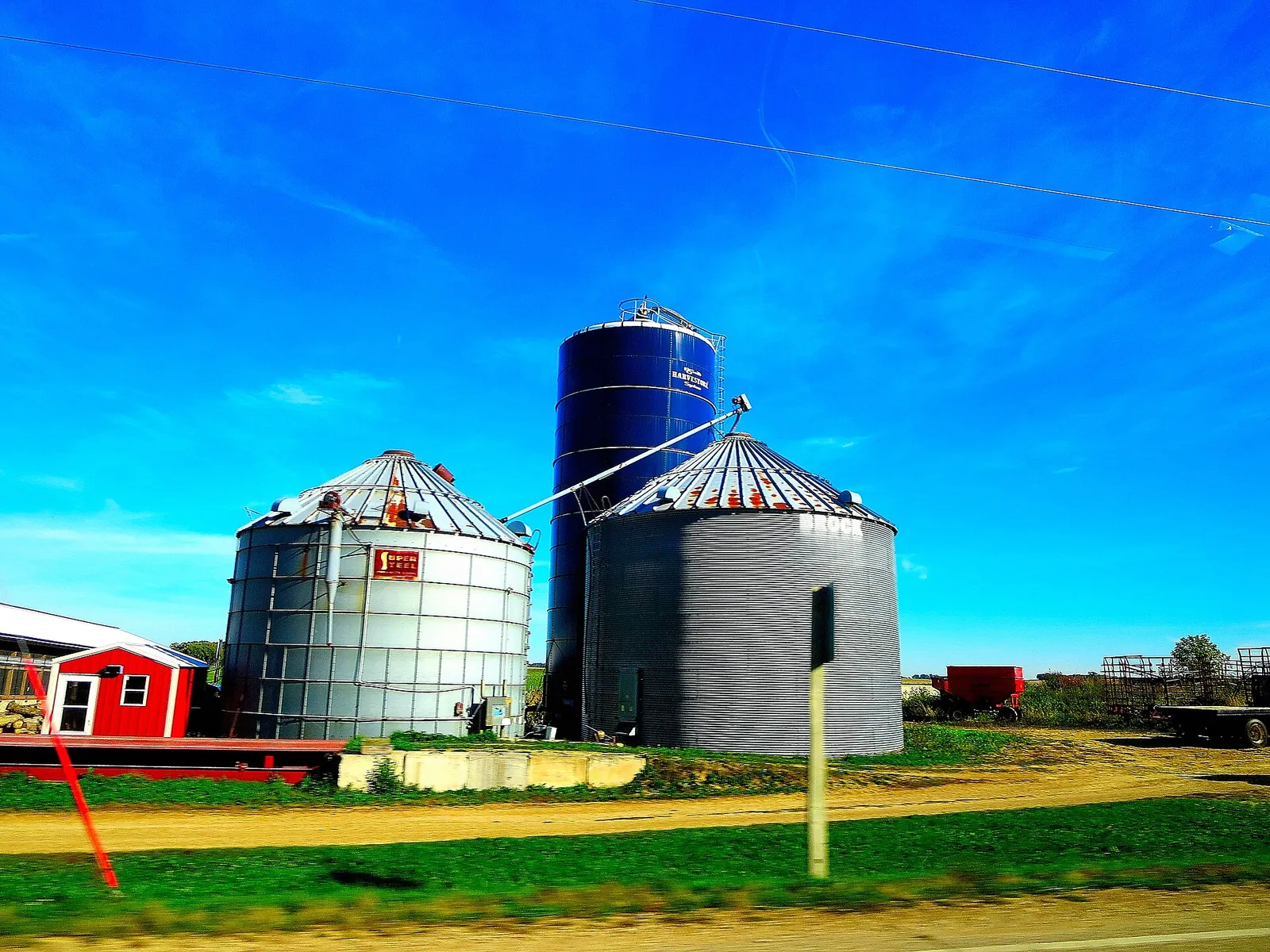
A grain bin and its roof
The bin is a cylinder.
The roof is a cone on the same radius.
Grain fills the space. Paint covers the outside.
Steel grain bins on a farm. Each body is a cylinder, and each roof is a cone on the same radius. Volume tells a farmer how much grain fits inside. Surface area tells a builder how much steel or paint the outside needs.